

Growth pillar on short links in the marketing funnel: where a URL shortener and short link campaign fit from awareness to conversion with UTM, pixel, and stats.
URL shortener marketing is not a trick for making banners look tidy. In a modern funnel it is an operations layer: one stable public address, a destination you can swap when the offer changes, UTM and pixels attached cleanly, and clicks you can read by short link campaign. This pillar doubles as a practical UTM pillar and a map of growth short links for marketers, agencies, and SMEs - strategy and standards, not a settings walkthrough. Start at /url-shortener.

Where short links sit in the marketing funnel
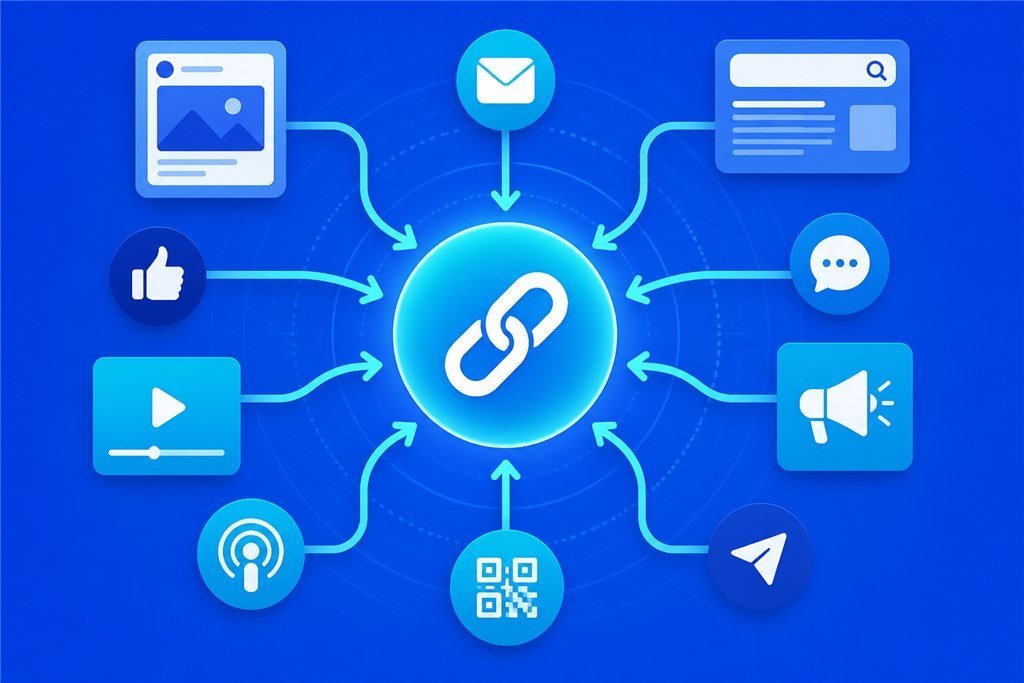
Think of four stages: awareness → click → landing or biolink → conversion. The short link lives between awareness and the destination. It does not replace creative, pricing, or the conversion page. It is the pipe with a meter on it. Paste long destination URLs straight into ads, bios, SMS, or posters, and every landing change means editing dozens of places you already published. That is the operational problem URL shortener marketing is built to solve.
A shortener separates two jobs that teams keep mixing up: the public address people see, and the destination behind it that can change with the campaign. The second payoff is a click layer that does not depend on how Meta, Google, or TikTok each define a click, a view, or an attribution window. A middle URL shows how often that published address was touched before anyone reached the page.
Pair short links with short links and UTM when you need source reading. Pair them with tracking on biolink and short-link destinations when you need audiences. When the destination is a multi-CTA social hub, connect the story to biolink marketing strategy. SMEs fail when they treat shorteners as a side utility. Agencies fail when every person invents aliases on the fly. Then nobody knows which campaign carries real traffic, nobody turns weak spend off, and nobody scales winners with confidence. Treat URL shortener marketing as part of the operating system, not as a convenience feature.

Naming short link campaigns for teams and agencies
Naming is shared language, not decoration. A good convention lets a new hire read a link in five seconds and keeps month-end reporting from turning into archaeology:
/{brand}-{channel}-{YYYYMM}-{offer}
examples: acme-meta-202608-flash
acme-tt-202608-leadmagnet
acme-bio-ig-202608-shop
Keep the brand short. Normalize channels (meta, gg, tt, zalo, email, sms). Use campaign month and year. Use an internal offer code - do not stuff SEO keywords into the alias. Avoid fb1, test, and final-final2. Agencies with many clients should add a client prefix or separate projects in Appifio.
Minimum ops sheet: alias, destination URL, UTM, create date, owner, active or closed. Review that row before you raise budget. How-tos live on the shortlink Page and settings Page - this article stays at the operating standard. If a junior cannot explain where an alias points and which UTM it carries, the link is not ready for paid. That gate prevents most “mystery traffic” tickets agencies hate answering on Friday nights. It is also the spine of an internal UTM pillar: without naming, you do not have a measurement pillar.

UTM pillar thinking: UTM, pixels, and click stats together
Three layers answer three different questions. UTM tells the source story inside analytics or CRM. Pixels help ads platforms learn events and build audiences. Click stats show how hard the published URL itself pulled. Drop one layer and weekly meetings become taste contests.
A disciplined SME paid stack looks like this: every paid URL goes through a short link; destinations carry consistent UTM; the landing - and the bio if it is the hub - has the right pixel; each day, read alias clicks before you argue about ROAS. Low clicks point at creative or placement. High clicks with weak leads point at landing or offer - raise bids last, not first. Deep UTM detail lives in the spoke on measuring ads with short links and UTM. Pixel placement belongs in the biolink and short-link tracking article. Click reporting lives on the statistics Page.
Do not ritualize the stack on day one. One primary Meta Pixel, one UTM rule page, and ten clean aliases is enough to learn. Add complexity when multiple brands, markets, or agencies touch one property. Separate debug metrics (alias clicks) from decision metrics (conversions). Mixing them is how teams kill good ads after a bad landing day - or keep bad ads alive because “the link got clicks.” Growth short links live in that discipline, not in how short the string looks.
Stable bios and campaign short links - do not mix the jobs
A bio is the long-term social door: several CTAs, seasonal updates, brand continuity. A campaign short link is a measurable address you can retarget, re-destination, and close when the offer ends. Paid should usually carry its own short link and UTM. The overall bio can keep one stable hub URL; campaign buttons on that bio can still point at short links.
When a creative goes viral, do not scramble every URL already printed on posters or seeded with influencers. Keep the alias. Change the destination behind it if you must. That operational flexibility is why URL shortener marketing earns its place beyond “the URL looks nicer.”
If the destination is a sales bio, read biolink for sales next. If you need platform-specific hub layouts, compare Instagram, TikTok, and YouTube link-in-bio patterns in that spoke. The principle stays the same: one long-term hub, many measurable campaign pipes.
Teams that blur the jobs end up editing the bio every time a promo ends - or freezing paid creatives because the only URL they published was the hub. Separate the roles on paper once, and both layers get quieter.
When expiry and link protection actually matter
Not every short link needs a password or an expiry date. Clear risk cases do: internal coupons, sensitive documents, landings that should only live for a flash window, partner URLs under time-bound contracts. Then expiry and protection are strategic controls - they stop coupons from living forever in group chats.
For Blog PR: public links carrying strong offers need a close plan. How to enable passwords, schedules, and targeting belongs on Pages, not in marketing copy. If your team forgets to close campaigns, put expiry on the publish checklist the same way you put UTM there. The downside is money and trust. A dead promo still reachable a week later trains audiences to wait for discounts. Closing the pipe is offer discipline, not an optional technical nicety.
Expiry also protects reporting. An alias that should have died still collecting clicks after the offer ends pollutes the week’s read and makes a weak creative look “still working.” Treat close dates as part of URL shortener marketing hygiene, the same way you treat naming.

Growth short links when agencies run many clients
Agencies live or die by repeatable clean process. A short-link onboarding template should include alias rules by brand, a standard UTM table, allowed pixels, a go-live reviewer, and a weekly audit cadence. Give each client a clear namespace. Never reuse a shared “sale” alias across five customers. Never let juniors publish unpaid-UTM links into high-budget ads.
At handoff, send a link map: alias → destination → UTM → pixel → placement. Clients who understand it optimize faster; agencies reduce “where does this go?” tickets. If the client already has a biolink, short links do not replace the bio - they measure campaigns pouring into the bio or landing.
A simple health check works: green means UTM, tested redirect, and an owner; yellow means one field missing; red means live in ads with broken measurement. Review red first every Monday. Process beats heroics when you manage dozens of properties. That is growth short links at agency scale - and the difference between a short link campaign and technical debt dressed as marketing.
Cluster map: short links and tracking
This pillar is the reading hub for the shortlink cluster and the narrative home for URL shortener marketing standards. Continue with Measure ads with short links and UTM; then Facebook Pixel on biolink and short-link destinations; when the destination is a sales bio, read biolink for sales plus biolink marketing strategy. Tool landing: URL shortener. Pages cover what a shortlink is, settings, and statistics.
Read in order: understand funnel position (this article) → attach clean UTM (UTM spoke) → place pixels on the real touchpoint (tracking spoke). Do not jump to pixels while aliases are still named final2.
If you only have time for one internal training this month, train naming and the three-layer stack. Creative workshops without a readable pipe just create prettier confusion.
Ops checklist before you scale
- Lock the alias convention and write it into the ops sheet.
- Create short links by convention; test redirects on mobile 4G.
- Attach full UTM; confirm the pixel on the destination.
- Place URLs in ads, bio, or email; note placement clearly.
- After 48 - 72 hours, read clicks before scaling budget.
- When the campaign ends: update destination or apply expiry as planned.
Weekly rhythm and the first ninety days
Block thirty to forty-five minutes each week: skim live alias clicks, reconcile conversions, retire dead aliases, and normalize drifted naming. Write down who creates aliases, who puts them into ads, and who reads stats. Before scale: iOS and Android redirect checks plus pixel plus UTM. If the week has no paid: still audit organic, QR, and SMS pipes. Archive the alias map at month-end.
First two weeks of a quarter: one offer, one destination, one measurement method. Weeks three to six: small traffic, one variable change per week. Weeks seven to twelve: scale only what is proven. At quarter end, hold a short meeting - what to keep, what to kill, what to double. SMEs do not need a strategy department; they need a habit of writing things down.
URL shortener marketing wins when the team treats aliases as shared language. It fails when everyone “makes a quick link” and forgets the sheet.
Three ops mistakes that cost more than missing features
Mistake one: many people can publish, nobody owns the map. Three people create aliases; nobody updates the sheet. Ghost URLs end up in ads. Fix it with one row: name, job, review date.
Mistake two: measuring one layer, then optimizing another. Watching short-link clicks and declaring the landing dead, or watching Ads Manager ROAS and declaring UTM useless. Each layer answers one question. Clicks ask whether the pipe was touched. UTM asks which source. Pixels ask what ads machines learned. CRM conversions ask whether leads became money.
Mistake three: mixing experiments with infrastructure. Changing a destination this week is an experiment. Changing the naming convention mid-month breaks infrastructure. Primary pixel, brand domain, and UTM source/medium rules are infrastructure - touch rarely. Buttons, headlines, and utm_content are experiments - allowed to die after two weeks.
Preventing these three mistakes takes a fixed calendar block, a one-page sheet, and a rule against changing five things in one day. A team of one to three can run this if they treat operations as the product.
A useful meeting habit: open the alias sheet beside Ads Manager and CRM. Ask pipe questions first, source questions second, money questions third. That order keeps URL shortener marketing from becoming a debate about taste.
QR, SMS, and posters - short links beyond the feed
Not every campaign lives on social. QR on a menu, SMS flash sales, event posters, and name cards all need short, stable addresses. Long URLs on paper invite typos; short links reduce friction and let you change destinations when the event ends without reprinting.
Naming still applies: add qr, sms, or print into the alias so month-end reporting does not dump everything into “other.” Write physical placement on the sheet - “QR table 12,” “SMS wave 3” - the same way you write ad placement. When numbers diverge, you will know whether the pipe or the placement failed.
Offline shorteners also separate organic social from event traffic. Without that split, teams blame the algorithm while a poster carried half the clicks. An offline short link campaign still needs UTM and a close plan - not only a pretty short string.
Before a large event: test QR with a real phone camera on 4G, and confirm destination plus pixel. After the event: expire or point back to the always-on hub so dead promos do not linger on walls.
In short
URL shortener marketing is growth infrastructure: a stable address, a changeable destination, readable clicks. Convention plus UTM plus pixels in the right places build clean pipes for agencies and SMEs. Start at /url-shortener; go deeper on the UTM spoke; place pixels in the tracking article.
FAQ
How is this blog pillar different from the
/url-shortenerlanding?The landing is the commercial hub and signup/tool CTA. The blog pillar explains where short links sit in the funnel, measurement standards, and links to spokes plus Page docs. The two URLs do not replace each other.
Is free tier enough for a small campaign?
Usually enough to learn naming, UTM, and reading clicks. When alias volume, custom domains, or team needs grow, check plans on the subscription Pages.
Is a pixel required if we already use UTM?
They play different roles. UTM helps you read source in analytics/CRM. Pixels help ads platforms optimize and build audiences. Serious paid SMEs should use both.
Should one short link cover every channel?
Not if you want channel comparison. Split by channel or campaign; a stable bio can keep one hub, while paid should use dedicated short links with UTM.
Does changing destination wipe old click history?
Typically you keep alias click history while the new destination serves the new offer. Confirm in link statistics and note the change in the ops sheet.